
Poverty Oatgrass Seeds (Danthonia spicata)
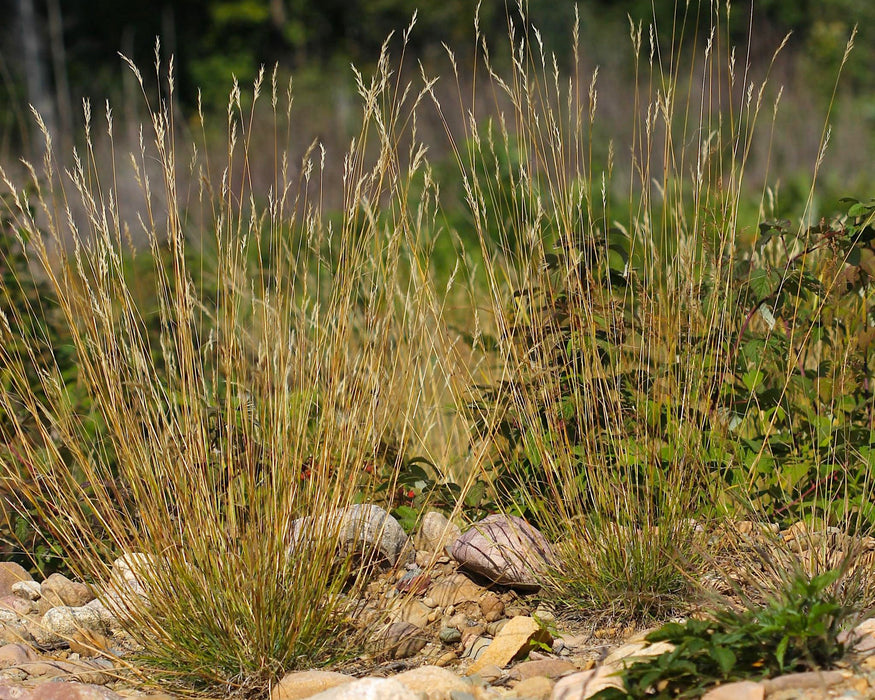
The common name of this unusual, low-growing, curly-leaved grass refers to the fact that it grows most favorably on impoverished ground, where few other plants have the ability to thrive. Occurring in scattered, local populations across much of temperate North America (only absent in parts of the central Great Plains), poverty oatgrass tolerates full sun to partial shade, and dry, nutrient-poor, coarse soils where other grasses struggle – imagine remote rocky bluffs, ‘goat prairies,’ and desolate lonely places of thin, ancient soils. In these locations, this small, non-competitive, slow growing grass most happily persists.
Yet, with leaves that stay between 4 to 6-inches in length, and seedheads arising to only about 12-inches in height, this tufty little grass is also a standout for wild lawns, incorporating tremendously well with low-growing wildflowers without crowding them out. (It’s been identified as an excellent performing species in the Native Lawn project trials at Cornell University).
Poverty oatgrass is a caterpillar host plant for various skipper butterflies (Hesperia spp.) – and for the marvelously mysterious Chryxus arctic butterfly (Oeneis chryxus) – a rare-ish treebark-camouflaged creature that shows up like a divine forest sprite unexpectedly in places as diverse as Alaska, and Michigan and New Mexico – a butterfly that appears and then disappears, leaving you to wonder if you ever actually saw it, much like this grass that it feeds upon.
7000+ seeds (8.0 grams).